
What did early modern life actually feel like?
We visited Agecroft Hall and Gardens in Richmond with Jill Pesesky, Curator of Education, and Dr. Peter Kirwan, Professor of Shakespeare and Performance at Mary Baldwin University and Trustee of the American Shakespeare Center. Together, they explore how space shapes experience, how Twelfth Night Or What You Will grows out of a season of celebration and misrule, and why community is at the heart of both Agecroft Hall and the ASC’s Blackfriars Playhouse.
TWO SPACES BUILT FOR GATHERING
Agecroft Hall and the ASC’s Blackfriars Playhouse were built centuries apart and for different purposes, yet both are places designed for people to gather, to witness, and to participate together.
Agecroft Hall is not a replica. It is an English manor house that once stood in Lancashire, dismantled and rebuilt along the James River. From the beginning, it was a working place shaped by relationships across class and community.
“They would have had a community of servants who work in the house who keep it running. They would have had a community of tenant farmers who were doing the work out in the fields. And they would have been an important place for gathering for the community… a nice big space like this shows how everybody in the community would have gravitated to a house like that.”
— Jill Pesesky
The Blackfriars Playhouse, opened in 2001 and now celebrating it’s 25th anniversary, is the first-ever re-creation of Shakespeare’s indoor theatre. Rather than freezing history in time, it invites audiences to rediscover how plays work when actors and audiences share space.
“If Agecroft is a working farm and the Blackfriars is a working theater, the working theater side of the Blackfriars is not about asking audiences to cosplay as 16th century, 17th century audience members, but rather to engage into the kinds of professional relationship that one might have had in the period.”
— Dr. Peter Kirwan
In both places, architecture does more than frame an experience. It shapes relationships, movement, and the way people encounter one another.
TWELFTH NIGHT: THE HOLIDAY AND THE PLAY
Twelfth Night is both a holiday season and a Shakespeare play, each built around celebration, misrule, and time spent together.
Christmas in Tudor England was not quiet or sentimental. It was an adult holiday stretching from Christmas Day through Epiphany, marked by feasting, music, games, storytelling, and visiting with neighbors. Work slowed, and celebration took center stage.
“It was a holiday that involved a lot of debauchery, especially before the English Civil War…So it was really a time for everybody to relax a little bit, enjoy some food, enjoy some decorating, enjoy some games—a lot of games—a lot of ghost stories too, which is something you see a little bit with A Christmas Carol, of course.”
— Jill Pesesky
One of the defining traditions of the season was misrule, a temporary loosening of social norms that allowed people to experiment with different roles and identities. That same spirit runs through Shakespeare’s Twelfth Night.
“One of the most important parts of the Twelfth Night holiday was the appointment of the Feste figure, right—the fool, the lord of misrule at these parties. Twelfth Night is a play and a period which both evoke carnival time…And for me, Twelfth Night’s misrule comes in the fact that it’s not clear-cut. It’s often treated as like the upstairs-downstairs play. We spend so much time with the servant characters or people who are not nominally in charge of events, but these are the characters who are determining the tone and the mood of the play.”
— Dr. Peter Kirwan
Feste moves freely between households. Sir Toby Belch leans into excess. Malvolio attempts to reshape his place in the world. Viola disguises herself as Cesario and navigates relationships from a new vantage point. The play asks what becomes possible when the rules bend.
COMMUNITY, PARTICIPATION, AND SHARED LIGHT
At both Agecroft Hall and the Blackfriars Playhouse, learning is not passive. It happens through participation, presence, and shared experience, where history and theatre come alive through the people in the room together.
At Agecroft, school programs invite students to step inside Shakespeare’s world by performing scenes and discovering that being an audience member is an active role. Students are encouraged to respond, cheer, and engage, often for the first time.
“At first a lot of them are like, “Nope. I don’t. I feel weird. I don’t want to interrupt them.” And getting them to engage where that’s also a part of the experience—sometimes if they have never experienced that when they go to theater, if they’ve been told their whole lives they have to be very quiet and just watch and clap—it just sort of blows their mind that they’re allowed to even cheer or holler in the middle of a live performance and that that’s not a bad thing.”
— Jill Pesesky
At the Blackfriars Playhouse, that same philosophy shapes every performance. Actors and audiences remain visible to one another throughout the show, sharing light, space, and responsibility for the story unfolding.
“But I think that’s a beautiful kind of point of comparison between the embodied experience of walking around Agecroft and the embodied experience of going to the playhouse: that it’s experiencing history, but it’s doing it with your whole body and your whole experience, right? You’re not just sitting reading about it and separating yourself from it. You’re immersing yourself in it and learning new ways to participate in the world.”
— Dr. Peter Kirwan
Taken together, Agecroft and the Blackfriars show how early modern life was not meant to be observed from a distance, but lived through shared space, shared time, and shared attention.
In both spaces, history and theatre come alive when people gather, participate, and respond to one another. That shared energy is what turns a visit into an experience and a room into a community. It’s the feeling of being part of something together.
Experience Twelfth Night at the Blackfriars Playhouse
Twelfth Night Or What You Will opens February 19 at the American Shakespeare Center’s Blackfriars Playhouse in Staunton, Virginia. Step into a space where actors and audiences share the same room, the same light, and the same story, and where Shakespeare’s comedy of misrule unfolds in real time and real community.
Book Your Tickets to Twelfth Night Or What You Will NowVisit Agecroft Hall & Gardens
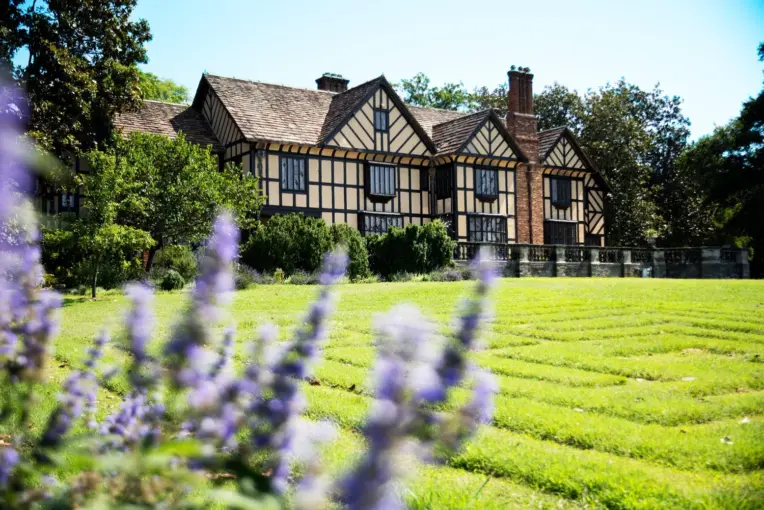
Continue your journey into early modern life at Agecroft Hall & Gardens in Richmond, Virginia. This historic English manor house offers immersive interpretation, seasonal programming, and welcoming spaces designed for gathering, conversation, and shared experience.
Upcoming highlights at Agecroft include:
- Free Gardens-Only Admission (January–February), an invitation to explore the historic grounds during the winter season
- Special Focus Tour: Love & Marriage in Tudor Times, an intimate guided tour examining relationships, power, and partnership in the early modern world
- Agatha Christie Book, Bingo, and Trivia Night, an evening of literary play, mystery, and community in a historic setting