
Emily Oleson discusses her approach to bringing movement to As You Like It.
In researching dance sequences for the American Shakespeare Center’s Summer 2026 production of As You Like It, I wanted to find source material that may have been performed in Elizabethan and other European courts. For the scene that introduces the female protagonists of the play, Rosalind and Celia, Director José Zayas wanted to focus on the young women practicing a dance in private. Energetically, this was meant to be quite distinct from both the lively country dance-adjacent revel that concludes the 1978 film version of AYLI starring Helen Mirren, and also different from the stately kabuki dance in Kenneth Branagh’s 2006 film adaptation, which is a formal performance in a courtly setting. Our dance was to portray a rehearsal: intimate in its familiarity, and almost tedious for Rosalind as a mover, to support the dialogue around her frustration and restlessness.
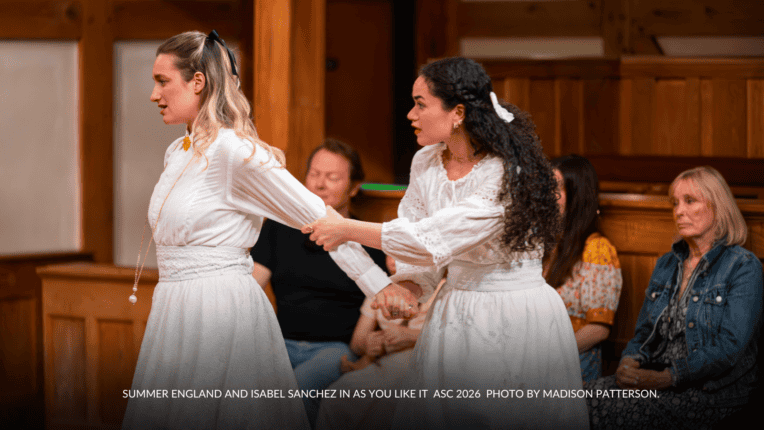
José and I picked some choreography for actors Summer England and Isabel Sanchez to “practice” in their performance, a Pavanne called “Belle qui tiens ma vie,” or “Beauty who holds my life.” The Renaissance dance and music company performing in the clip below is El Canto de las Vihuelas. This work was published in 1589 by French cleric Thoinot Arbeau in his dance manual Orchesographie:
Orchesographie (1589) was Arbeau’s defense of social dancing, which was coming under attack from Calvinists across Europe by the late sixteenth century. As a scholar of social dances myself, I was surprised that I had never come across Arbeau before to this project, although I tend to research more contemporary social dances generally. (Of course, I was not surprised to learn my friend, colleague, and ASC-veteran Doreen Bechtol already knew of him.) Thoinot Arbeau, whose real name was Jehan Tabourot, was also fascinating to me in his various connections to the story and themes of AYLI. He lived in a dangerously divided society in the aftermath of the Protestant Reformation, and used the pseudonym for publication, going “undercover” in a sense like characters in our play. Along with the courtly pavan above, there are many other dances in the manual, and the dances of non-aristocrats are represented in print for the first time (Pittaway 2017)—just as Shakespeare has woven multiple subplots bringing together characters from different walks of life through his narrative. And Orchesographie is written as a dialogue for two fictional characters to discuss the weighty matters of what is lost to time and what remains.
Early music researcher Ian Pittaway gives us this excellent and detailed article from 2017 about the “Belle qui tiens ma vie” and its author, Arbeau. Pittaway’s blog post includes a performance of the song with its lyrics that accompanies the Pavanne in the original 1589 text. Apparently, the song is a bit of an early music chestnut—I was not sure if that would be bad, good, or irrelevant to the rest of the creative team.
As some of my own background is in traditional dances to Irish and old-time music, I was nervous to bring up something that might seem too obvious, because I understand that a lot of more experienced musicians in those communities don’t necessarily want to play the same 20 tunes all the time. Every community has their sensitivities and preferences, but as this was my first project with the ASC, I was eager to make qualitative contributions. I overcame my shyness (as I usually do) and brought the clip above to Zayas, who connected with the graceful and measured energy of the piece.
I was comforted to observe that the potential ubiquity of “Belle qui tiens ma vie” in early music circles also seemed irrelevant to the rest of the team—because in ASC’s Summer 2026, it is to be performed to an instrumental version of “It’s Only Time” by Magnetic Fields! Excellent.

Pittaway quotes a passage from Arbeau’s book where his (somewhat comedic) defense of social dance seemed to me to dovetail with the epilogue Rosalind delivers at the end of As You Like It. He advises: “And if you desire to marry, you must realize that a mistress is won by the good temper and grace displayed while dancing …” No spoilers intended, but suffice to say that, to me, Arbeau and Roselinde seemed to be cut from the same cloth (pun intended).
As Zayas describes in his own interview about the play, a major theme was time.
Social dances have their own relationship with time: repetition and ritual marking its passage, rhythm and musicality within a dance a measure of fluency and creativity, rehearsal and memorization a very real physical labor that takes very real amounts of time (though that time and labor may also be viewed as recreation).
I don’t exactly know why, but Zayas’ production of As You Like It, for me, foregrounded the value of time with loved ones, in spaces one loves, and in pursuit of what one loves. Time is not infinite; even less infinite is the remainder of the run of As You Like It.
— Emily Oleson, M.F.A., C.M.A., A.B.D.
Emily Oleson will be joining the ASC Fall 2026 Repertory creative team as Movement Director.
ASC Fall Repertory Dates:
- Pay-What-You-Will – Thursday, September 3, 2026 7:30 PM
- Opening Night – Friday, September 4, 2026 7:30 PM
- First Matinee – Saturday, September 5, 2026 2:00 PM

Emily Oleson
Emily Oleson is a dance scholar and crossover dancer interested in a broad range of styles, from traditional Appalachian flatfooting, to forms of Irish dance, partner dance, contemporary urban dances, and vernacular jazz. She received her MFA in Dance at the University of Maryland College Park in May 2012 and a certification in Laban-Bartenieff Movement Analysis in 2015 from the Laban-Bartenieff Institute of Movement Studies. Find more of her work at www.emilyoleson.com.